Galapagos snorkeling: the complete guide to snorkeling in the Galapagos Islands
Snorkeling in the Galapagos Islands means swimming alongside sea lions, marine iguanas, penguins, and reef sharks in the wild — no scuba certification required. As part of Ecuador’s Galapagos Marine Reserve, it’s widely considered the best snorkeling in Ecuador, and one of the most accessible, close

Galaxy Cruises
September 19, 2026
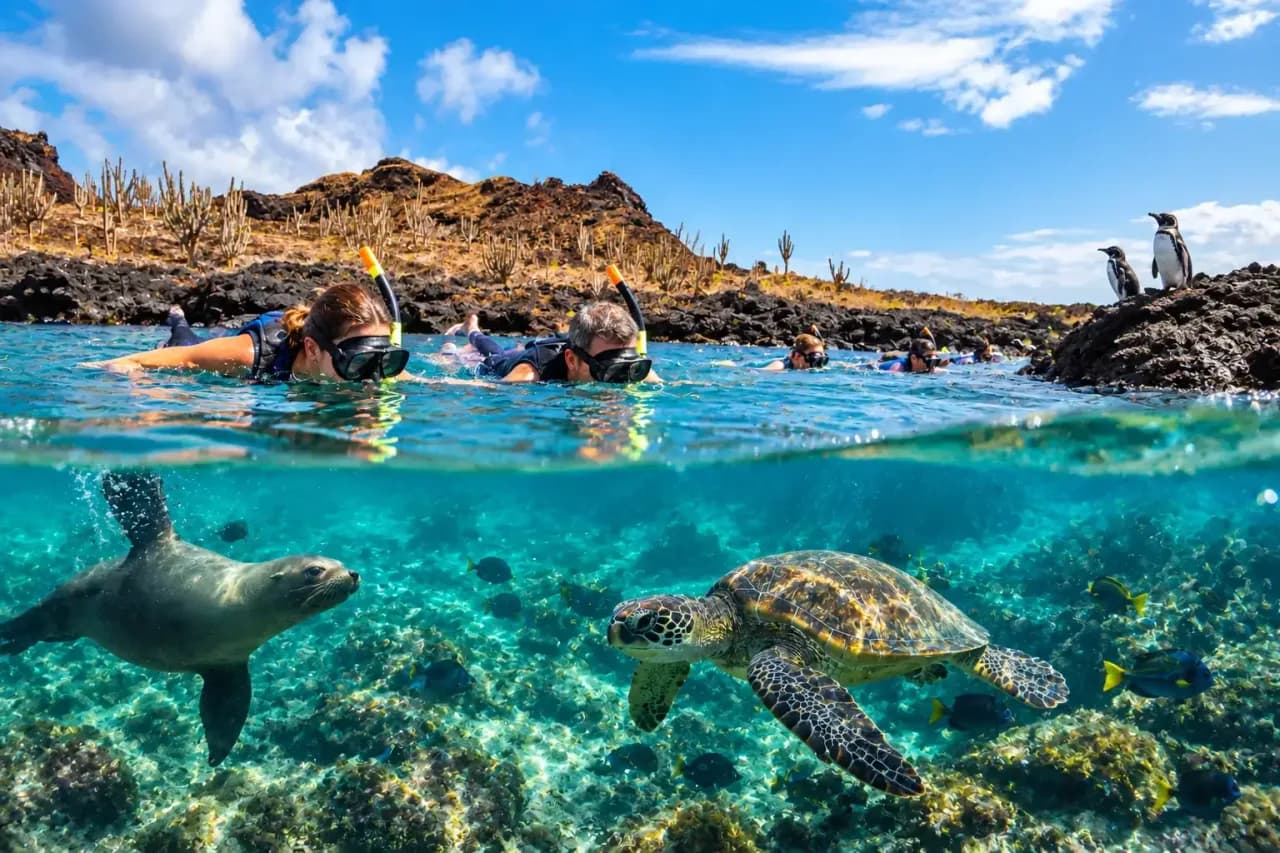
Snorkeling in the Galapagos Islands means swimming alongside sea lions, marine iguanas, penguins, and reef sharks in the wild — no scuba certification required. As part of Ecuador’s Galapagos Marine Reserve, it’s widely considered the best snorkeling in Ecuador, and one of the most accessible, close-up wildlife encounters anywhere on the planet.
Unlike a typical tropical snorkeling destination, the Galapagos isn’t built around coral reefs. Cold, nutrient-rich currents from the Humboldt and Cromwell systems collide with warm equatorial water here, which is exactly why the islands were declared a UNESCO World Heritage Site in 1978 and why over 30% of the wildlife you’ll meet in the water exists nowhere else on Earth. You come for the animals, not the coral — and that changes everything about how, when, and where you should snorkel.
Anyone planning a snorkeling Galapagos trip for the first time should know this guide covers the best spots island by island, the season that fits your priorities, what the water actually feels like, safety, gear, and how snorkeling from a small expedition ship compares to a land-based day tour.
Is snorkeling in the Galapagos worth it?
Yes — the Galapagos is consistently ranked among the best wildlife-watching destinations in the world, and snorkeling is the easiest way to experience its marine life without a dive certification. Curious sea lions, giant sea turtles, and marine iguanas grazing underwater are common on a single outing.
What makes it worth it isn’t a single “best beach” — it’s the range. Calm, shallow bays like Gardner Bay or Punta Carola are gentle enough for total beginners and kids, while exposed sites like Kicker Rock or Punta Vicente Roca deliver current-swept, big-animal encounters that rival scuba diving elsewhere in the world. The National Geographic Society has ranked the Galapagos among the planet’s premier diving and marine-wildlife destinations — the same waters snorkelers swim in every day.
Best time to visit Galapagos for snorkeling
There’s no bad month to snorkel in the Galapagos, however, September and October can be cold months for galapagos islands snorkeling . The choice is really about your priority. January through May brings the calmest, clearest water; June through November brings cooler water that’s richer in marine life, including the best odds of seeing hammerhead sharks.
Warm season (January–May): This is possibly one of the best time to snorkel in Galápagos. Water temperatures run roughly 75°F–82°F (24°C–28°C), seas are calmer, and underwater visibility typically reaches 60–100 ft (18–30 m). This is the easiest window for beginners, families, and undewater photography.
Cool, “garúa” season (June–November): The Humboldt Current pulls water temperatures down to roughly 64°F–74°F (18°C–23°C), visibility drops to 30–60 ft (9–18 m), but nutrient-rich upwelling brings in more plankton — and with it, more fish, rays, and the best odds of spotting hammerhead sharks while snorkeling. Many naturalist guides consider August through October the peak of this upwelling, when marine life activity is highest. A 3mm wetsuit makes a real difference in comfort during this period.
Shoulder months (June and November): Often cited by naturalist guides as the sweet spot — transitional water temperatures, thinning crowds, and a mix of both seasons’ wildlife.
For the full picture on rainfall, air temperature, and travel logistics across the year, see our guide to Galapagos weather and water temperature.
Can you snorkel in the Galapagos? Rules and what to expect
Yes, but here’s one of the most useful Galapagos snorkeling tips: most of it isn’t do-it-yourself. The Galapagos National Park manages nearly every coastline as a protected visitor site, and access to the best snorkeling spots — Kicker Rock, Los Tuneles, Devil’s Crown, Punta Vicente Roca — is only permitted aboard an authorized tour or cruise with a certified naturalist guide. A handful of beaches near the inhabited towns (Tortuga Bay, Playa Mann, Punta Carola on San Cristóbal) can be reached and snorkeled independently.
The core rules that affect snorkelers, straight from the Galapagos National Park regulations:
- Stay at least 2 meters (6 feet) from all wildlife — no touching, feeding, or chasing.
- Snorkel only within designated visitor sites, with your assigned guide.
- Use reef-safe, mineral-based sunscreen; several operators prohibit chemical sunscreens aboard.
- Leave no trace: nothing is removed from the water or islands, including shells and coral fragments.
Galapagos snorkeling tours: how and where to book
“Galapagos snorkeling tours” usually means one of two different products, and it’s worth knowing which one you’re booking. A day tour is a single outing sold by a local operator in Puerto Ayora, Puerto Baquerizo Moreno, or Puerto Villamil, covering one or two nearby sites. A multi-day expedition cruise builds snorkeling into a full itinerary — typically two excursions a day — reaching sites no day tour can, with the same naturalist guide throughout your trip.
For travelers the best snorkeling tours in galapagos who want the entire itinerary built around them, Galaxy Cruises also runs fully private snorkeling charters aboard the ultra-private Galaxy Stella, (A luxury yacht offering a unique adventure and the best snorkeling in the Galápagos, with complete safety) set to your own pace, sites, and schedule rather than a shared group departure.
See how snorkeling from an expedition cruise compares to a day tour in detail below, or go ahead and book a Galapagos snorkeling cruise.
The best Galapagos snorkeling spots, island by island
Snorkeling in Ecuador is defined by visit to the Galápagos Islands, and with that in mind, every spot is essential. Every inhabited island in the Galapagos offers snorkeling, but the sites vary enormously in access, difficulty, and what you’ll see. Here’s the breakdown that matters before you book.
San Cristóbal
Kicker Rock (León Dormido) is the island’s headline site: a sheer volcanic pinnacle split by a narrow channel where currents funnel in eagle rays, sea turtles, and — in the cooler months — schooling hammerhead sharks. It’s an advanced snorkel: deep water, no bottom in sight, and current that a guide will actively manage. Isla Lobos, by contrast, is about as gentle as Galapagos snorkeling gets, built around a resident sea lion colony that treats snorkelers like playmates. Punta Carola, a short walk from Puerto Baquerizo Moreno, is the rare premier-feeling site you can reach without booking a tour.
Santa Cruz
For the best snorkeling Santa Cruz Galapagos has to offer, start with Las Grietas — a narrow volcanic fissure of impossibly clear, brackish water a short walk from Puerto Ayora — calm, current-free, and ideal for a first Galapagos snorkel. Tortuga Bay pairs a 45-minute walk through cactus forest with a protected cove (Playa Mansa) where sea turtles and rays are common. From Santa Cruz, most operators also run day trips to Santa Fe Island, known for a resident sea lion colony and marine iguanas basking on volcanic rock at the waterline.
Isabela
Isabela is the biodiversity heavyweight. Los Tuneles is a maze of collapsed lava arches and bridges where snorkelers regularly find seahorses, white-tip reef sharks resting in sandy channels, and rays gliding beneath the arches. Punta Vicente Roca, on the Bolívar Channel between Isabela and Fernandina, sits in one of the coldest, most nutrient-rich pockets of the archipelago — expect penguins, sea turtles, and, on a lucky day, an ocean sunfish (mola mola). Las Tintoreras, just offshore from Puerto Villamil, is named for the white-tip reef sharks (“tintoreras”) that rest in its narrow channel by the dozen; it’s calm enough for beginners and dense enough with wildlife to feel like a wildlife documentary.
Floreana
Devil’s Crown Galapagos snorkeling is not for beginners: this eroded volcanic cone (Corona del Diablo) is now a jagged ring breaking the surface a short swim from Champion Islet, and it’s one of the most current-swept, advanced sites in the islands — and one of the most rewarding, with reef sharks, rays, dense schools of tropical fish, and an outside chance of hammerheads. It’s cruise-only: there’s no land base close enough for a day tour.
Pinzón and the remote northern islands
Pinzón is better known for its giant tortoise breeding program than for snorkeling — the channel between Pinzón and Isla Rábida offers a worthwhile but modest snorkel (sea lions, occasional rays), and it’s usually a stop on multi-day itineraries rather than a headline site. The real reward for going further north is Bartolomé, the single best place in the islands to snorkel with Galapagos penguins as they torpedo past at speed, and Genovesa (Darwin Bay), a remote fur-seal colony reachable only on extended expedition-cruise itineraries. These northern and central sites are exactly where a multi-day cruise earns its keep: they’re simply not reachable on a day tour from the main towns.
Now, the question of which are the best snorkeling spots in the Galapagos Islands? is up to you; choose wisely and always prioritize your safety.
Marine life you’ll see while snorkeling in the Galapagos
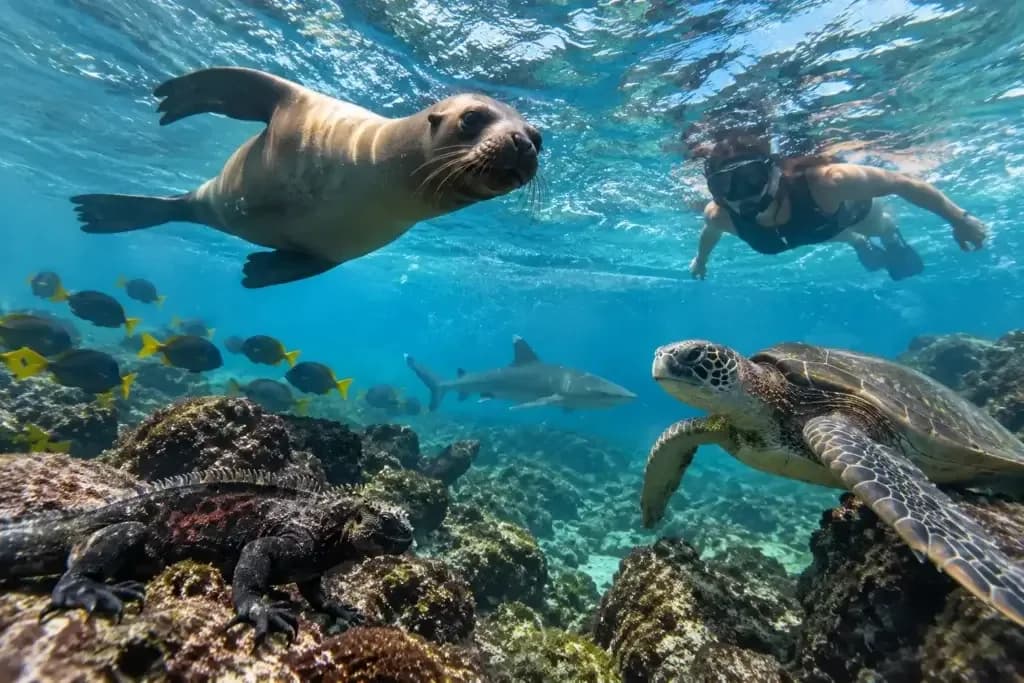
Because the Galapagos isn’t a coral-reef system, the appeal isn’t dense schools of reef fish — it’s large, charismatic, endemic animals at close range. On a typical week of snorkeling you can reasonably expect:
- Galapagos sea lions — curious, playful, and the most reliable close encounter in the islands.
- Marine iguanas — the world’s only sea-going lizard, grazing on algae underwater at sites like Las Tintoreras and Punta Vicente Roca.
- Galapagos penguins — the only penguin species found north of the equator, best seen at Bartolomé and around Isabela.
- Green sea turtles — present at nearly every site, year-round.
- Rays — golden rays, eagle rays, and occasionally manta rays gliding over sandy bottoms.
- White-tip reef sharks — common and harmless to snorkelers, especially at Las Tintoreras.
For full species profiles and where to find land-based wildlife too, see our guide to Galapagos wildlife.
Hammerhead sharks and whale sharks: setting realistic expectations
This is where honesty matters. Schooling hammerhead sharks and whale sharks are, above all, associated with Darwin and Wolf Islands in the far north — sites reached almost exclusively by dedicated multi-day scuba liveaboards, not standard snorkeling excursions. Kicker Rock Galapagos snorkeling trips and outings to Devil’s Crown can occasionally turn up hammerheads during the cooler months, but it’s a bonus, not a guarantee.
If a near-certain encounter with schooling hammerheads or whale sharks is the goal, Galapagos liveaboard diving is the way to get there — Galaxy Diver II and Galaxy Diver III run dedicated itineraries of up to 19 dives, including Darwin and Wolf, aboard vessels built specifically for that experience.
Snorkeling with Galapagos penguins
Snorkeling galapagos islands is a unique, once-in-a-lifetime experience; that is why the island, Bartolomé and the waters around Isabela (Las Tintoreras and Punta Vicente Roca) are the most consistent spots to snorkel alongside Galapagos penguins. They’re fastest in the water during their peak feeding activity, roughly June through September, when the cooler, plankton-rich season keeps them hunting close to shore.
Is it safe to snorkel in the Galapagos?
Yes — snorkeling in the Galapagos is considered very safe when done with a certified guide, and serious incidents are rare. The islands are widely regarded as one of the safest wildlife destinations in the world, and the animals you’ll encounter are, with very few exceptions, not aggressive toward humans.
On sharks: white-tip reef sharks and the occasional hammerhead are not aggressive toward snorkelers and are usually the highlight of a trip, not a risk. Serious incidents involving snorkelers and sharks in the Galapagos are exceptionally rare, and most published safety concerns online relate to isolated cases where people ignored guide instructions or entered strong-current zones without supervision — which is exactly why every reputable operator requires a naturalist guide at every site.
On currents: the exposed, advanced sites (Kicker Rock, Devil’s Crown, Punta Vicente Roca) can have strong, unpredictable currents. Guides assess conditions before every entry and will call off a snorkel if conditions turn unsafe — this is the single biggest safety advantage of going with a small, guide-led group rather than swimming independently.
On sea lions: playful almost all the time, but give a wide berth to large territorial bulls, especially during breeding season (roughly August–November).
Practical safety habits: stay within sight of your guide, never touch or chase wildlife, keep at least 2 meters (6 feet) of distance, snorkel with a buddy, and wear a life vest if you’re not a strong swimmer — most operators carry them for exactly this reason.
What to wear and pack for Galapagos snorkeling
The right gear to wear for Galapagos snorkeling is a swimsuit, a 3mm wetsuit if you’re visiting June through December, reef-safe mineral sunscreen, and a well-fitted mask and snorkel.
Wetsuit: A 3mm wetsuit is the standard recommendation, essential from June through December when water temperatures sit in the 64–74°F (18–23°C) range. From January to May, at 75–82°F (24–28°C), many snorkelers are comfortable without one, though a thin wetsuit still helps for longer sessions.
Sunscreen: Use reef-safe, mineral (zinc oxide) sunscreen. The equatorial sun is intense even on overcast garúa days, and several Galapagos operators restrict chemical sunscreens aboard to protect the marine reserve.
What not to wear: skip loose jewelry (snag risk on rock and lava formations) and very bright, high-contrast swimwear near sea lion colonies during pupping season, when territorial bulls are more reactive to anything unfamiliar in their space. A rash guard or long-sleeve top does more for sun protection than sunscreen reapplication alone.
Beyond your wetsuit and swimwear, pack water shoes for rocky lava entries, a dry bag for your phone or camera, and motion-sickness tablets for panga rides between the boat and the water.
Gear checklist: mask and snorkel (properly fitted — this matters more than brand), fins, water shoes, a dry bag, and motion-sickness tablets if you’re prone to seasickness. Check with your expedition team ahead of time on what to pack for your Galapagos expedition and what snorkeling gear is provided onboard versus what you should bring yourself.
Snorkeling from a Galapagos expedition cruise vs. day tours
Where you snorkel from changes what you’ll see as much as the season does.
A day tour from Puerto Ayora, Puerto Baquerizo Moreno, or Puerto Villamil is a reasonable way to snorkel one or two sites near town. But the sites that make the Galapagos genuinely unlike anywhere else — Devil’s Crown, Punta Vicente Roca, Bartolomé, Genovesa — sit far enough from the inhabited islands that a small expedition ship is the only practical way to reach them, arriving before the day-tour boats and leaving before the crowds do.
This is the core of how Galaxy Cruises builds its itineraries: small luxury yachts like Galaxy Zibó and Galaxy Stella, the catamaran M/C Alya, and the sustainability-focused EcoGalaxy — built with 50% less wood than a conventional vessel and engineered for energy efficiency — each carry a resident naturalist guide and run daily panga excursions to sites chosen for wildlife, not convenience. For travelers who want the highlights without committing to a full live-aboard cruise, Galaxy Skape runs focused day expeditions to the archipelago’s prime wildlife hotspots, and the Santa Cruz Express combines a land-based stay with daily cruise excursions — a practical way to add real snorkeling days to a shorter Galapagos trip.
Snorkeling vs. scuba diving in the Galapagos
Snorkeling and scuba diving in the Galapagos overlap in the animals you can see, but they aren’t the same trip. Snorkeling requires no certification, stays at the surface, and covers the vast majority of visitor sites — including nearly everything described above. Scuba diving requires certification, reaches deeper water, and is the only way to reliably reach Darwin and Wolf, the two sites most associated with schooling hammerhead sharks, whale sharks, and the archipelago’s biggest pelagic encounters.
If the underwater side of your trip is the priority — not an add-on to a broader itinerary — Galapagos liveaboard diving is worth considering on its own. Galaxy Diver II, recognized by National Geographic as a premier global diving destination platform, and the newer Galaxy Diver III run dedicated week-long itineraries of up to 19 dives, built around Galapagos diving conditions and seasons rather than a mixed wildlife-and-landscape agenda.
Frequently asked questions about Galapagos snorkeling
Is snorkeling in the Galapagos worth it?
Yes. It’s one of the few places in the world where snorkelers regularly encounter sea lions, marine iguanas, penguins, and sharks in a single outing, without needing a scuba certification.
Do I need to know how to swim to snorkel in the Galapagos?
Basic swimming ability is required at most sites, though beginner-friendly locations like Isla Lobos, Las Grietas, and Punta Carola have calm, shallow water. Life vests are available on request for less confident swimmers.
Do I need a wetsuit for Galapagos snorkeling?
A 3mm wetsuit is recommended, and essential from June through December when water temperatures drop to 64–74°F (18–23°C). It’s optional January through May, when the water is closer to 75–82°F (24–28°C).
What colors should I avoid wearing while snorkeling in the Galapagos?
There’s no strong evidence that a specific color attracts sharks in the Galapagos, but many guides suggest skipping bright, high-contrast swimwear (yellow, white, silver) in open water, since low-contrast blues, blacks, and greens draw less curiosity from marine life.
Is it safe to snorkel with sharks in the Galapagos?
Yes. The white-tip reef sharks and occasional hammerheads snorkelers encounter are not aggressive toward humans and are considered a highlight rather than a hazard when you snorkel with a certified guide.
Are there a lot of sharks in the Galapagos?
Yes. White-tip reef sharks are common at sites like Las Tintoreras, and Galapagos and hammerhead sharks appear seasonally at Kicker Rock and Devil’s Crown — but none are considered a threat to snorkelers under normal, guided conditions.
Can you snorkel in the Galapagos without a guide?
Only at a handful of beaches near the inhabited towns, such as Tortuga Bay and Punta Carola. Nearly every other premier site — Kicker Rock, Los Tuneles, Devil’s Crown — requires an authorized tour or cruise with a naturalist guide, per Galapagos National Park regulations.
What is the best month to snorkel in the Galapagos?
January through May offers the calmest water and best visibility. June through November brings cooler, nutrient-rich water with more marine life activity, including better odds of hammerhead sightings. June and November are the shoulder months that balance both.
Is there a bad time to snorkel in the Galapagos?
Not really — every month offers snorkeling. The two seasons simply trade calm, clear water (January–May) for cooler, marine-life-rich water (June–November); most first-time visitors still favor January through May for the easiest conditions.
Which Galapagos island has the best snorkeling?
Isabela offers the widest range, from the calm, shark-filled channel at Las Tintoreras to the lava-arch snorkeling at Los Tuneles. San Cristóbal’s Kicker Rock and Floreana’s Devil’s Crown are the top choices for advanced snorkelers chasing bigger animals and current.
Can beginners and children snorkel in the Galapagos?
Yes. Sites like Isla Lobos, Las Grietas, Gardner Bay, and Punta Carola have calm, shallow water well suited to beginners and kids, and most operators provide life vests.
Do Galapagos cruises include snorkeling excursions?
Most multi-day expedition cruises, including Galaxy Cruises itineraries, build daily panga excursions with snorkeling stops into the schedule as a core activity, not an optional add-on.
Can I book a private Galapagos snorkeling charter?
Yes. Galaxy Cruises offers fully private charters aboard the ultra-private Galaxy Stella, letting you set your own pace, sites, and schedule instead of joining a shared group itinerary.
What’s the difference between Galapagos snorkeling and scuba diving?
Snorkeling stays at the surface, needs no certification, and covers almost every visitor site. Scuba diving requires certification and reaches deeper, current-swept sites like Darwin and Wolf, where schooling hammerhead sharks and whale sharks are most reliably seen.
Plan your Galapagos snorkeling trip
The Galapagos rewards travelers who experience it with more than their eyes — Galaxy Cruises builds every itinerary around that idea, letting you feel the current at Kicker Rock, hear the bark of a sea lion colony at Isla Lobos, and watch a marine iguana graze inches from your mask. Explore our fleet and book a Galapagos snorkeling cruise to build an itinerary around the sites, seasons, and marine life that matter most to you.
Kuratiert von Gvoya
Auf der Suche nach der richtigen Reise?
Entdecken Sie kommende Abfahrten von Galaxy Cruises und finden Sie die passende Route.
Reisen von Galaxy Cruises entdeckenQuelle: galaxycruises.com