Galapagos wildlife: what you’ll actually see, island by island
The first time most of our guests step off the panga onto Española, they freeze. Not because something is dangerous — because a sea lion is asleep across the trail and a blue-footed booby is standing a yard (one meter) away, completely unbothered. That’s the Galapagos wildlife experience in one imag

Galaxy Cruises
October 1, 2026
The first time most of our guests step off the panga onto Española, they freeze. Not because something is dangerous — because a sea lion is asleep across the trail and a blue-footed booby is standing a yard (one meter) away, completely unbothered. That’s the Galapagos wildlife experience in one image: animals that evolved with almost no reason to fear people.
But here’s what most “Galapagos animals” lists leave out: the wildlife isn’t spread evenly across the archipelago. Waved albatrosses nest on essentially one island. Flightless cormorants live only on the western edge. Red-footed boobies crowd onto one remote northern island. The islands on your itinerary decide which creatures you’ll actually see — so this guide sorts the animals of the Galapagos Islands the way our naturalist guides think about them: what lives here, what lives only here, and where exactly you’d stand to see it.
Galapagos wildlife: the short version
Galapagos wildlife is famous for two things: an extraordinary share of species found nowhere else on Earth, and animals that let you walk right past them. The Galapagos Islands fauna is mostly reptiles, seabirds, sea lions, and marine life — very few land mammals made it this far offshore. What you see depends less on luck and more on which islands your route visits.
Animals only found on the Galapagos Islands
The endemic animals of Galapagos are the reason the islands are famous: most of the land animals you’ll meet here exist nowhere else. According to Galápagos Conservancy, 97% of the islands’ reptiles and land mammals, about 80% of the land birds, and more than 20% of the marine species are endemic.
That’s why “unique Galapagos animals” isn’t a marketing phrase — it’s a scientific description. These are the Galapagos endemic species — native animals from Galapagos and nowhere else — that our guests most often travel specifically to see:
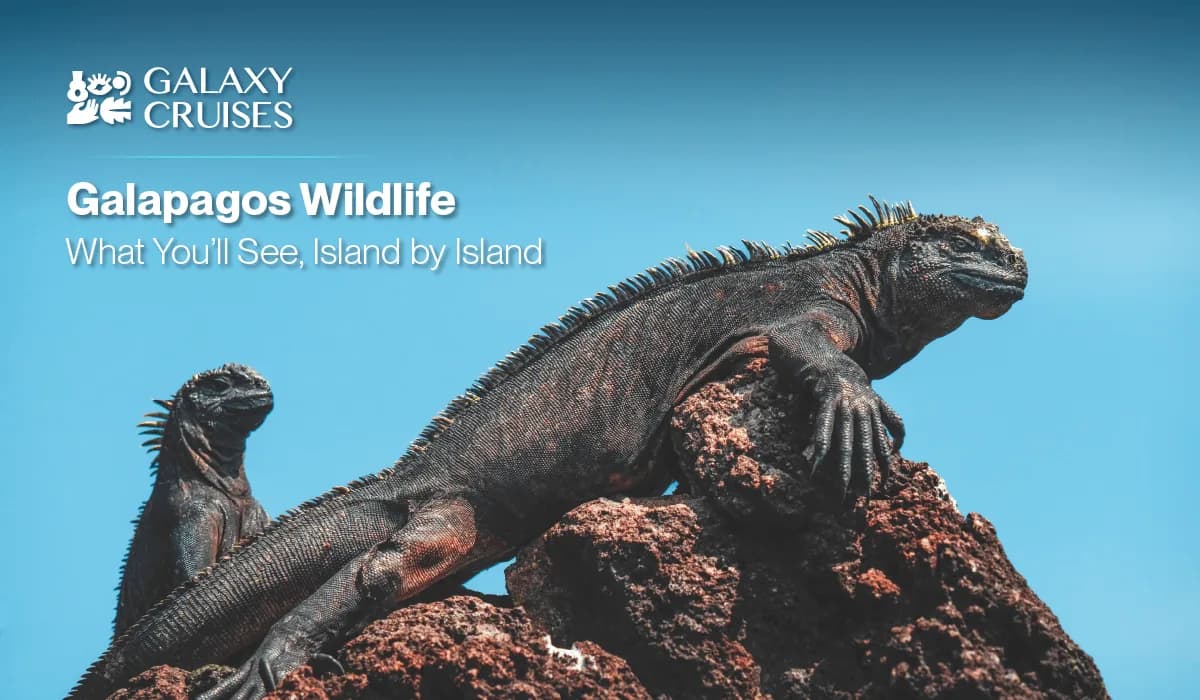
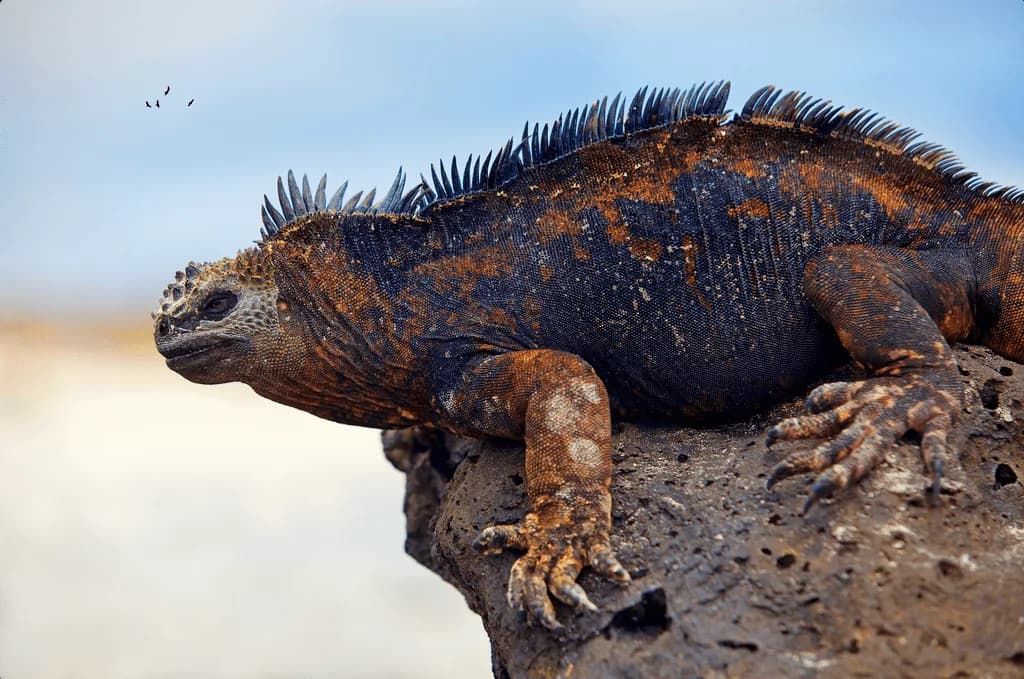
- Marine iguana — the only lizard in the world that feeds in the ocean, diving to graze on algae and then basking on black lava to warm back up.
- Flightless cormorant — the only cormorant on Earth that lost the ability to fly; found only on Fernandina and the western coast of Isabela.
- Galapagos penguin — the only penguin that lives on the equator, with some birds around northern Isabela technically living in the Northern Hemisphere.
- Galapagos giant tortoise — not one species but several, historically with distinct types on different islands, a pattern that helped shape Charles Darwin’s thinking on how species change.
- Galapagos land iguana — including a separate species found only on Santa Fe, and the rare pink iguana that lives only on the slopes of Wolf Volcano, northern Isabela.
- Waved albatross — the only tropical albatross; nearly the entire world population breeds on Española.
- Darwin’s finches — 13 species in Galapagos, each with a beak shaped for a different food source.
Why so many animals are only found here: the islands sit roughly 600 miles (1,000 km) off mainland Ecuador. Whatever reached them — flying, swimming, or rafting on floating vegetation — evolved in isolation for millions of years with few predators, which is why so many rare Galapagos animals ended up on one island and nowhere else.
Galapagos Islands animals: the main species by category
Beyond the endemic headliners, a core cast of animals on the Galapagos shows up on almost every itinerary — just in different combinations depending on the islands you visit.
Listing every species on Galapagos would take a field guide, so here are the Galapagos species you’re most likely to see, including a few Galapagos island creatures most visitors don’t expect:
What are Galapagos boobies?
Galapagos boobies are three species of seabird — blue-footed, red-footed, and Nazca — named by Spanish sailors from bobo (“fool”), because the birds showed no fear and landed on ships’ decks.
- Blue-footed booby — the star of the courtship dance, lifting bright-blue feet one at a time; easy to see on Española, North Seymour, and Isabela.
- Red-footed booby — the only Galapagos booby that nests in trees and shrubs; the big colony is on Genovesa.
- Nazca booby — the largest of the three, white with a black mask; common on Española and Genovesa.
Giant tortoises and land iguanas
Giant tortoises gave the islands their name — galápago is an old Spanish word for a type of saddle, after the shape of their shells — and many live well past 100 years. The most reliable places to see them in the wild are the Santa Cruz highlands and Isabela.
Land iguanas look almost prehistoric: bulky, yellow-orange, and slow-moving. On Santa Cruz, the classic spot is Cerro Dragón on the northwest coast; on Santa Fe, you’ll find a paler species that lives only on that island; North Seymour also has a healthy, reintroduced population.
Sea lions, marine iguanas, and other marine life
Of all the Galapagos island animals, you’ll see sea lions most —on beaches, on docks, and on park benches in Puerto Baquerizo Moreno, San Cristóbal. Marine iguanas pile up in dark heaps on lava rock between dives.
Underwater, nearly every snorkel stop brings green sea turtles, curious sea lion pups, and schools of reef fish. For what to expect below the surface, see our guide to Galapagos snorkeling.
Galapagos Islands wildlife: which animals live on each island?
The animals at the Galapagos Islands aren’t evenly spread across the archipelago. Every Galapagos itinerary follows a fixed route approved by the National Park, so the islands on your route decide which animals you’ll realistically see. Use this table to check before you book.
Animals on Santa Cruz Island, Galapagos
Santa Cruz is the most visited island and one of the most varied for wildlife: in a single day you can see giant tortoises roaming the highlands, marine iguanas on the beach, and land iguanas at Cerro Dragón.
What to look for on Santa Cruz:
- Giant tortoises grazing freely in the green highlands, especially in the wetter months.
- Marine iguanas on the sand and lava around Tortuga Bay.
- Land iguanas and flamingo lagoons at Cerro Dragón.
- Darwin’s finches and Galapagos mockingbirds almost everywhere.
- Tortoise breeding programs at the Charles Darwin Research Station in Puerto Ayora.
Because Santa Cruz sits at the center of the archipelago, it’s also the easiest base for daily expeditions — our 7D-6N Galapagos island hopping and Quito City Tour combines the island with two days aboard the Galaxy Skape.
Which islands are best for wildlife?
There’s no single “best” island — it depends on the animal you care about most. As a rule of thumb from our guides:
- For seabirds: Española and Genovesa.
- For endemic species you can’t see elsewhere: Fernandina and western Isabela.
- For giant tortoises: Santa Cruz and Isabela.
- For a bit of everything in one place: Santa Cruz and North Seymour.
On Galaxy Stella (12 guests), your whole ship lands as a single naturalist-led group, so you spend the time at each site with the animals, not waiting for other groups to clear the trail.
Is it safe to swim with sharks in the Galapagos?
Yes. Sharks are a normal part of snorkeling and diving in Galapagos, and attacks on people are extraordinarily rare.
Here are the real numbers behind that answer:
- According to IGTOA, the International Galapagos Tour Operators Association, only seven unprovoked shark attacks have been recorded in the islands since 1954.
- In a recent year with more than 200,000 visitors, there wasn’t a single shark incident.
- There is no resident great white shark population in Galapagos.
The sharks you’re most likely to see are whitetip reef sharks resting on the bottom and Galapagos sharks cruising past. The big hammerhead schools gather far north, around Darwin and Wolf, which you can only reach on a dedicated dive trip — our Galapagos liveaboard diving trips aboard Galaxy Diver II and Galaxy Diver III include 19 dives, 12 of them at Darwin & Wolf.
Invasive and endangered species: what’s really at risk
The biggest threat to Galapagos wildlife isn’t visitors — it’s the invasive species that arrived with people over the last two centuries. Several endangered species in the Galapagos Islands — and many other Galapagos Islands species — are still recovering from that damage.
Invasive species in the Galapagos
Invasive species in Galapagos are animals, plants, and insects brought by humans that compete with or prey on native wildlife. The most damaging ones:
- Goats — stripped entire islands of the vegetation giant tortoises depend on.
- Rats — eat tortoise hatchlings, iguana eggs, and seabird chicks.
- Feral cats and dogs — prey on iguanas, young birds, and reptiles.
- Philornis downsi — a parasitic fly whose larvae feed on nestling birds; one of the main threats to Darwin’s finches today.
Eradication efforts have worked on a scale few places can match. Project Isabela removed feral goats from Santiago and northern Isabela, one of the largest island restoration efforts ever attempted, and native vegetation and tortoise populations have been recovering since.
Endangered species in the Galapagos Islands
These are the species under the most pressure right now:
This is part of why the Galapagos National Park limits group sizes, fixes itineraries, and requires a certified naturalist guide on every visit. Choosing an operator with a lower-impact fleet matters too — EcoGalaxy, for example, is a catamaran built with 50% less wood than a conventional vessel. For current population numbers and program results, Galápagos Conservancy publishes regular updates.
See it for yourself, island by island
A list of species tells you what exists in the Galapagos; the islands on your route decide what you’ll actually meet. The same week can mean albatross and boobies on Española or penguins and flightless cormorants in the far west — so pick the animals first, then the itinerary that reaches them.
Got a species at the top of your list? Compare our small-ship itineraries and we’ll point you to the route that gets you there.
Frequently asked questions about Galapagos wildlife
What are five animals only found in the Galapagos Islands?
The marine iguana, flightless cormorant, Galapagos penguin, Galapagos giant tortoise, and waved albatross (which breeds almost only on Española). The pink land iguana of Wolf Volcano is another.
What animals are found in the Galapagos Islands?
The main animals found in the Galapagos Islands are giant tortoises, marine and land iguanas, sea lions, fur seals, three booby species, frigatebirds, waved albatross, Darwin’s finches, Galapagos penguins, flightless cormorants, sea turtles, rays, and several shark species.
What is the most famous Galapagos animal?
The giant tortoise and the blue-footed booby compete for the title — the tortoise gave the islands their name, and the booby’s blue-footed courtship dance is the most photographed moment on most trips.
What are boobies in the Galapagos?
Seabirds — blue-footed, red-footed, and Nazca boobies — named by Spanish sailors from bobo (“fool”) because they showed no fear of humans.
Are there great white sharks in the Galapagos?
No. There’s no resident great white population. You’ll mostly see whitetip reef sharks, Galapagos sharks, and, at Darwin and Wolf, hammerheads.
Is it safe to swim in the Galapagos with sharks?
Yes. Only seven unprovoked shark attacks have been recorded since 1954, according to IGTOA, and snorkeling is always guided.
Which Galapagos island has the most wildlife?
There’s no single winner. Española and Genovesa are best for seabirds, Fernandina and western Isabela for endemic species, and Santa Cruz for variety in one place.
What Galapagos Islands creatures can you see while snorkeling?
Green sea turtles, sea lions, rays, whitetip reef sharks, marine iguanas feeding on algae, and — around Bartolomé and western Isabela — Galapagos penguins. See our Galapagos snorkeling guide for the best sites.
Where can I see giant tortoises in the wild?
In the Santa Cruz highlands and on Isabela, plus the breeding programs at the Charles Darwin Research Station in Puerto Ayora.
Are there invasive species in the Galapagos?
Yes — goats, rats, feral cats and dogs, and the parasitic fly Philornis downsi. They’re a bigger threat to native wildlife than visitors are.
What endangered animals live in the Galapagos?
The mangrove finch, pink land iguana, and waved albatross are critically endangered; the Galapagos penguin is endangered; the Galapagos hawk is vulnerable.
Can you touch the animals in the Galapagos?
No. National Park rules forbid touching, feeding, or crowding wildlife — see How to Plan a Trip to the Galapagos Islands for the full visitor rules.
When is the best time to see Galapagos wildlife?
It depends on the species — waved albatrosses are only on Española from roughly April to December, for example. See best time to visit the Galapagos Islands for the month-by-month calendar.
Sources referenced: endemism figures from Galápagos Conservancy; waved albatross and Galapagos hawk status from Galapagos Conservation Trust; shark statistics from IGTOA; island-by-island wildlife compiled from Galaxy Cruises itineraries and our naturalist guides’ field experience.
Curated by Gvoya
Looking for the right voyage?
Browse upcoming departures from Galaxy Cruises and find the right itinerary.
Browse Galaxy Cruises VoyagesSource: galaxycruises.com