Galapagos diving: seasons, Darwin and Wolf, and what to expect
The Galapagos diving season is really two seasons. The cool season, from June to November, brings the best odds of hammerheads and whale sharks at Darwin and Wolf. The warm season, from December to May, brings warmer, clearer, calmer water. Both are worth the trip. The Darwin and Wolf islands sit in

Galaxy Cruises
October 27, 2026
The Galapagos diving season is really two seasons. The cool season, from June to November, brings the best odds of hammerheads and whale sharks at Darwin and Wolf. The warm season, from December to May, brings warmer, clearer, calmer water. Both are worth the trip.
The Darwin and Wolf islands sit in the far north of the archipelago, past the islands most visitors ever see, and Darwin and Wolf diving is possible only by liveaboard. Diving at Galapagos Islands sites this remote is a different trip from a day on the water near the inhabited islands. Around Darwin and Wolf, the currents push food up the walls and the big animals follow. What you find on a given week depends on the month, the water temperature, and the current.
This guide covers when to go, what Darwin and Wolf are known for, what Galapagos diving conditions are like, and how a dive cruise works. For requirements and a typical day on board, read our Galapagos diving liveaboard guide.
When is the best time to dive in the Galapagos?
The best time to dive in the Galapagos depends on what you want to see, and the two Galapagos diving seasons are very different. June to November is the cool season, with the best odds of hammerheads and whale sharks. December to May is warmer, with clearer water and calmer conditions.
Divers who ask about the best time to dive the Galapagos usually want one of two things: big animals or comfort. For big animals, the best time to scuba dive in the Galapagos is the cool season; for comfort, it is the warm season. Neither is a bad time to dive, and the best time to dive the Galapagos Islands depends on which you value more.
Cool season: June to November
The Humboldt Current is strongest from June through November, and it carries the nutrients that feed the whole food chain. Divers Alert Network describes July to November as the high season for dive travel, with abundant whale shark sightings but lower visibility and stronger currents. ScubaDiving.com points to September through November as the best window for hammerheads, which tend to sit in deeper, colder water at that time. August and September are also the coldest months, so Galapagos diving in August and September means the strongest hammerhead and whale shark season, with the coldest water and the most plankton of the year.
If you are curious what the surface looks like at this end of the season, see what October is like in the Galapagos.
Warm season: December to May
The Humboldt Current weakens in December as the warmer Panama Current gains strength. The water is more comfortable, the currents are usually easier, and visibility often improves. Our best time to visit the Galapagos guide puts February and March as the clearest and calmest months. The trade-off is fewer big schools, so this is the season for divers who care more about comfort and clear water than about hammerhead numbers.
Best time to dive Galapagos by month, with water temperature
Galapagos diving water temperature runs from about 64 °F (18 °C) in August and September to about 80 °F (27 °C) in February and March.
These are typical sea temperatures from our guide to the best time to visit. The western islands, Fernandina and Isabela, run colder than the rest.
Two months show the range. Galapagos diving April is the end of the warm season, with water around 76 to 78 °F (24 to 26 °C) before the Humboldt Current strengthens in June. Galapagos diving August is the cold end, with water around 64 to 67 °F (18 to 19 °C) and the strongest currents.
Why is Darwin and Wolf diving worth the trip?
For Galapagos island diving built around big animals, the Darwin and Wolf islands are where divers go. Scalloped hammerheads gather there in large schools, whale sharks pass through in season, and both islands can be reached only by liveaboard.
The Galapagos Conservancy notes that the Galapagos Marine Reserve is one of only a handful of places on Earth where hammerheads gather in huge schools, with groups of up to several hundred seen near Darwin and Wolf at certain times of year. The Charles Darwin Foundation adds that currents concentrate food around both islands, which is part of why the sharks stay.
Galapagos hammerhead sharks
Galapagos hammerhead sharks are present at Darwin and Wolf all year, but not in the same numbers. A recent Charles Darwin Foundation study found that hammerhead biomass around the two islands was up to four times higher in the cool season than in the warm season. At night, many of them disperse across the marine reserve.
Encounters are never guaranteed. Divers Alert Network notes that sightings can be unpredictable, and that hammerheads can be shy even at the best sites. The scalloped hammerhead is also in trouble worldwide: in 2019, the IUCN moved it from endangered to critically endangered, according to the Galapagos Conservancy. Seeing a school here is something that is getting harder to do anywhere else. For more on the sharks and other marine life of the islands, see our island-by-island Galapagos wildlife guide.
Galapagos whale shark season
The Galapagos whale shark season at Darwin runs mostly through the cool months. The Charles Darwin Foundation reports that the whale sharks that arrive there are mostly adult females, and that most stay only about two days before moving on. Satellite tags have followed some of them more than 1,600 miles (2,700 km).
Whale sharks are not exclusive to the season. A Divers Alert Network trip report from May 2021, outside the usual window, recorded whale sharks on each of three dives at Darwin. That is one trip, not a promise. Treat a whale shark as a bonus in any month, and your odds as best between June and November.
Galapagos diving animals
Galapagos diving animals go well beyond hammerheads and whale sharks. Divers Alert Network lists Galapagos sharks, silky sharks, eagle rays, green sea turtles, dolphins, sea lions, and ocean sunfish (mola mola) among the animals divers meet in the islands.
For Galapagos diving iguana sightings, look to the western islands. Divers Alert Network places marine iguanas at Cabo Douglas, on Fernandina, where they slip into the shallows to feed on algae. They live above and below the waterline across several islands, and our Galapagos wildlife guide shows where to find them.
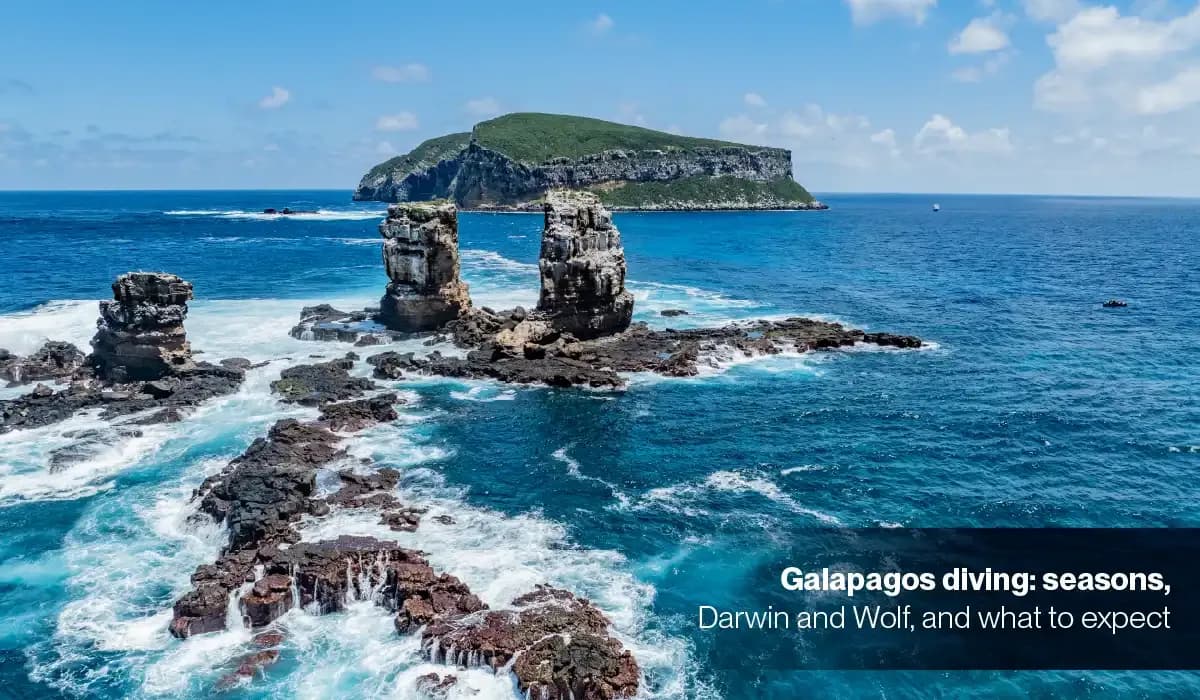
Darwin Arch diving after the collapse
Darwin’s Arch, the rock formation that made Darwin Island famous, lost its top to erosion in May 2021. Ecuador’s Environment Ministry reported the collapse, and CBS News noted that the two stone columns that held it up are still standing. The site is still a dive site, with the schools of hammerheads that made it known, so Galapagos diving Darwin Arch plans can still be built around the big animals.
The itineraries of our Galaxy Diver II and Galaxy Diver III list these dive sites:
A few of these have a reputation. Divers Alert Network reports Galapagos sharks coming reasonably close at Shark Bay, and an ocean sunfish cleaning station at about 80 to 100 feet (24 to 30 m) at Punta Vicente Roca, where the thermocline can also drop much colder, as it can at Cabo Douglas.
What are Galapagos diving conditions like?
Galapagos diving conditions are for experienced divers. Scuba diving in Galapagos means cool water, moderate to strong currents, typical visibility of 33 to 66 feet (10 to 20 m), and dives that often go deep.
Currents and visibility
- Currents: moderate to strong, and sometimes extreme, according to Divers Alert Network. Dive sites can close when surge and waves build, so flexibility matters.
- Visibility: typically 33 to 66 feet (10 to 20 m), with up to 98 feet (30 m) possible. Plankton in the cool season lowers it.
- Depth: the maximum depth on our Galaxy Diver itineraries is 98 feet (30 m). ScubaDiving.com notes that dives are usually deep, so it pays to look up now and then for dolphins, whale sharks, and hammerheads near the surface.
- Entries: all dives from our Galaxy Diver yachts start from a dinghy.
What Galapagos diving wetsuit do you need?
A 7 mm wetsuit is the standard answer. The yacht pages for Galaxy Diver II and Galaxy Diver III recommend 7 mm, and dry suits are not available on board. ScubaDiving.com suggests a 7 mm suit with a thick hood for repetitive dives, and Divers Alert Network describes layering 5 mm and 7 mm suits with a hooded vest and using gloves to grip rocks in the current.
In the warm months some divers are comfortable in less. If you are unsure, ask the dive team before you pack. In a strong El Niño year, you may need less still.
Nitrox
Nitrox lengthens no-decompression time on deep, repetitive dives, which is why ScubaDiving.com recommends enriched-air certification for Galapagos. On Galaxy Diver II and Galaxy Diver III, nitrox is included for divers who hold the certification, and a nitrox course is available for an additional fee.
Is Galapagos scuba diving for beginners?
No. Galapagos scuba diving at Darwin and Wolf is for experienced divers. Diving the Galapagos there means strong currents, deep dives, and cold water, which call for advanced certification and recent practice, and liveaboards are the only way to reach the best sites.
Divers Alert Network rates the Galapagos as suitable for at least intermediate divers, and ScubaDiving.com calls it a destination for advanced and adventurous divers only. Galaxy sets a minimum certification and a minimum number of logged dives for each departure, and our liveaboard guide lists them with a checklist of what to send before you book.
If you are not there yet, you can still see Galapagos marine life from the surface. Our Galapagos snorkeling guide covers the best spots by island.
What does a Galapagos diving trip with Galaxy look like?
Galaxy Diver II and Galaxy Diver III each run eight-day, seven-night Galapagos diving adventures from Baltra, with 19 dives, 12 of them at Darwin and Wolf, for up to 16 guests.
Galaxy Cruises, an operator based in Ecuador, sails both yachts with the same program. It starts with a check dive at Baltra. Then come four dives at Wolf one day, four at Darwin the next, and four more split between the two on the third, with the remaining dives at Fernandina, Isabela, Santiago, and Santa Cruz. The schedule can change with weather and sea conditions, and wildlife sightings are not guaranteed.
For the dive team, group size, equipment, and what to send before you book, read our Galapagos diving liveaboard guide. The details that differ between departures are on each yacht’s page: Galaxy Diver II and Galaxy Diver III.
How does El Niño change Galapagos diving?
El Niño warms the water and weakens the upwelling that feeds the Galapagos. Divers need less thermal protection, but the animals that follow the nutrients, hammerheads and whale sharks among them, have less to follow.
Divers Alert Network explains that reduced upwelling in El Niño years keeps the water warmer and leaves fewer nutrients available. The NOAA Climate Prediction Center is tracking the current event, so check its latest update before you book. Our El Niño and expedition yacht travel guide covers what it means for a trip.
Frequently asked questions about Galapagos diving
What is the best time to scuba dive in Galapagos?
It depends on the animal. For hammerheads and whale sharks, the best time to dive Galapagos Islands sites like Darwin and Wolf is the cool season, June to November. For warm, clear water, February and March are the clearest and calmest months, so that is the best time to dive in Galapagos if comfort matters most.
When is whale shark season in the Galapagos?
Mostly June to November, when the Humboldt Current is strongest. Divers Alert Network describes July to November as the high season for sightings, and they can happen outside it.
Can you see hammerheads in the Galapagos all year?
Yes, but numbers change. Hammerhead biomass around Darwin and Wolf is up to four times higher in the cool season than in the warm season.
What is the water temperature for diving in the Galapagos?
About 64 °F (18 °C) in the coldest months, August and September, and about 80 °F (27 °C) in February and March. The western islands run colder.
Do you need a 7 mm wetsuit to dive in the Galapagos?
Our Galaxy Diver yacht pages recommend 7 mm, and dry suits are not available on board. Some divers layer a 5 mm suit with a hooded vest. Ask the dive team before you pack.
Can you dive Darwin and Wolf without a liveaboard?
No. Divers Alert Network notes that liveaboards are needed to reach both islands.
How many dives are on a Galapagos liveaboard?
On Galaxy Diver II and Galaxy Diver III, 19 dives, including the check dive, with 12 at Darwin and Wolf.
Are there a lot of sharks in the Galapagos?
Yes, especially at Darwin and Wolf. The Galapagos Conservancy notes that hammerheads gather there in groups of up to several hundred at certain times of year, and Galapagos sharks and whale sharks are also seen. For the sharks you can meet at the surface and on shallower dives, see our Galapagos wildlife guide.
Is Galapagos diving good for beginners?
No. Strong currents and deep dives make it a destination for advanced divers, and Galaxy sets minimum certification and logged-dive requirements for each departure.
How difficult is diving in the Galapagos?
Difficult enough that it is for advanced divers. Currents are moderate to strong, dives are often deep, the water can be cold, and sites can close when surge and waves build.
What is the difference between a liveaboard and day diving in the Galapagos?
Darwin and Wolf can be reached only by liveaboard. Day trips from the inhabited islands stay in the central part of the archipelago, so they cover different sites.
Where else do you dive besides Darwin and Wolf?
The Galaxy Diver itineraries also include sites at Santa Cruz, Fernandina, Isabela, and Santiago, plus a check dive at Baltra.
Can you combine Galapagos diving and land tours on the same trip?
On Galaxy Diver II and Galaxy Diver III the program is built around diving. The only stop on land is in Santa Cruz on the last day, to see the giant tortoises. If you want more time on land, look at Galaxy Skape, our island hopping program with daily boat routes.
Is diving Galapagos on a budget possible?
Darwin and Wolf can be reached only by liveaboard, which sets a floor on the cost. Galaxy’s dive cruises start from USD 7,600, and promotions come up often, so ask a Galaxy advisor for current rates.
Plan your Galapagos dive trip
The season decides which animals you are most likely to meet, not whether the diving is worth doing. The cool months bring hammerheads and whale sharks, along with colder, greener water, and the warm months bring comfort and clearer water. Pick the season by the animal you most want to see, and be ready for current in either one.
When you are ready to look at dates, check availability for a Galapagos diving liveaboard with Galaxy Cruises.
Sources: Divers Alert Network, Galápagos Islands · ScubaDiving.com, 8 things to know before scuba diving in Galapagos · Galapagos Conservancy, scalloped hammerhead sharks · Charles Darwin Foundation, do all sharks behave the same? · CBS News, Darwin’s Arch collapses · NOAA Climate Prediction Center · Galaxy Diver II and Galaxy Diver III yacht pages and Galaxy Cruises best-time guide. Last updated: October 26, 2026.
Curated by Gvoya
Looking for the right voyage?
Browse upcoming departures from Galaxy Cruises and find the right itinerary.
Browse Galaxy Cruises VoyagesSource: galaxycruises.com